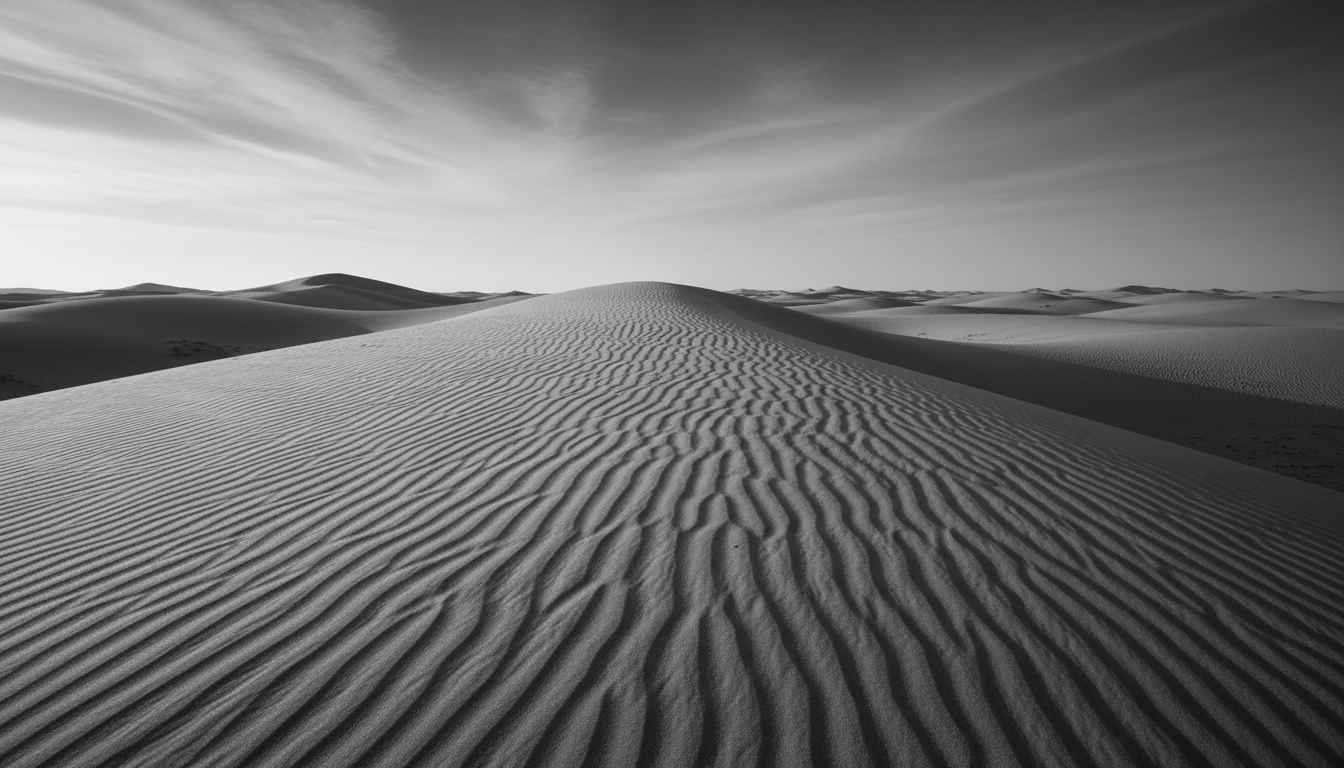
A journey of a thousand miles often begins with a single, unforgiving frame. In the barren stretches of deserts, where the sun scorches and the wind sculpts every dune, black and white photography emerges as the ultimate tool to immortalize the stark, haunting beauty of these landscapes. It is a realm where shadows, contrasts, and textures speak louder than color, demanding the photographer’s full attention and precision.
In the world of desert photography, black and white images are not just artistic choices – they are survival mechanisms for visual storytelling. Each ripple in the sand, every cracked earth pattern, and the skeletal forms of sparse vegetation are amplified in monochrome, creating drama and depth that color often dilutes. Here, we explore the most influential photographers, essential techniques, and practical guidance for mastering desert photography in black and white.
Quick Definitions
Desert Photography: Capturing landscapes, textures, and phenomena in arid environments.
Black and White Photography: Imagery that relies solely on shades of gray to convey tone, contrast, and mood.
Dune: A mound of sand shaped by wind, often found in deserts.
Golden Hour: The time shortly after sunrise or before sunset where light is soft and warm, ideal for photography.
High Contrast: The degree of difference between the darkest shadows and brightest highlights in an image.
The Masters of Desert Monochrome
Edward Weston: Sculpting Sand and Light
Weston’s desert work redefined how textures and forms are interpreted. His approach emphasized minimalism – isolating shapes like dune crests and weathered rocks in stark, high-contrast black and white. Weston’s photography is a blueprint for capturing the desert’s abstract qualities, showing that simplicity can evoke profound emotion.
Ansel Adams: Contrasts Carved in Sand
Although famous for his mountainous landscapes, Adams ventured into desert terrain, applying his signature Zone System to control exposure and tonal range. Every grain of sand and every shadowed ridge is rendered with meticulous precision. Adams’ legacy teaches that understanding light and exposure is critical for desert black and white photography, where detail can vanish in harsh highlights or deep shadows.
Michael Kenna: Minimalism Meets Desert Isolation
Kenna’s long-exposure, minimalist compositions highlight the serene and almost meditative qualities of desert landscapes. His work demonstrates that negative space, when paired with black and white processing, intensifies the viewer’s sense of solitude and scale.
Essential Techniques for Desert Black and White Photography
Harnessing Contrast
Deserts naturally offer high contrast: bright sunlit dunes against deep shadows. Use this to your advantage by shooting during early morning or late afternoon. Adjust exposure to preserve highlights without losing shadow details. High-contrast images dramatize the harsh beauty of the desert while providing depth and texture.
Textures and Patterns
Sand ripples, cracked earth, and rock formations are ideal subjects for black and white photography. Zoom in to emphasize repeating patterns or use wide angles to capture sweeping landscapes. Texture becomes the focal point, revealing the desert’s story beyond mere scenery.
Composition Principles
Strong lines guide the viewer’s eye across the frame. Leading lines formed by dunes or rock ridges create dynamic movement. Negative space can amplify isolation, while symmetry or minimalistic frames accentuate the starkness of the environment.
Alternative Options
For those without professional DSLRs, high-end mirrorless cameras or even advanced smartphone cameras can produce striking black and white desert images. Software such as Lightroom or Capture One allows you to enhance contrast, texture, and tonal balance without needing expensive gear. Budget-conscious photographers can experiment with filters and monochrome presets to emulate the masters’ style.
Who Should Avoid This?
Desert black and white photography is not for the faint-hearted or impatient. It demands harsh travel conditions, early mornings, and meticulous attention to detail. Those who struggle with extreme light conditions or complex post-processing may find it frustrating. Casual hobbyists without a willingness to invest in learning compositional techniques might prefer color photography or indoor projects.
Practical Gear and Prep
Tripods are indispensable for low-light or long-exposure shots. Polarizing filters help manage glare and improve texture definition. Protective cases, ample water, and navigation tools are critical due to the desert’s unpredictable environment. Digital photographers should carry multiple memory cards and spare batteries, as long exposures and high-contrast captures quickly drain resources.
The Role of Getty Images in Desert Black and White
For those unable to travel to remote deserts, Getty Images offers an unrivaled repository of royalty-free black and white desert photography. Here, professionals and enthusiasts alike can access high-quality images of dunes, salt flats, and desert flora. Whether for editorial use or creative inspiration, the collection provides an invaluable reference to understand composition, contrast, and texture in desert photography Getty Images.
Advanced Post-Processing Tips
Tonal Adjustments
Desert landscapes often feature extreme highlights and shadows. Adjusting tonal curves allows you to balance brightness and contrast, emphasizing textures without flattening the image. Dodge and burn techniques selectively enhance light and shadow for a sculpted, three-dimensional effect.
Black and White Conversions
Raw color images can be converted to monochrome using software, offering greater control over individual color channels. Desaturating specific tones can exaggerate dune shadows or accentuate sky gradients, achieving the desired emotional impact.
Noise Management
Long exposures or high ISO settings introduce noise that may compromise the clarity of sand textures. Careful noise reduction preserves detail while avoiding the artificial softness that can diminish the desert’s harsh aesthetic.
Iconic Desert Subjects
Dunes and Ripples
The rhythmic patterns of dunes are timeless black and white subjects. Capture them at low angles to highlight depth, or use aerial perspectives for abstract, wave-like compositions.
Desert Flora
Sparse vegetation like cacti or desert shrubs can add focal points. Their stark silhouettes against wide, empty backgrounds emphasize scale and isolation, hallmarks of desert imagery.
Skies and Storms
Desert skies, particularly during approaching storms or sunset, create dramatic contrasts with the arid ground. Long exposures can transform moving clouds into ethereal textures, enhancing the surreal feel of black and white compositions.
Potential Drawbacks
Extreme heat, sunburn, sand intrusion, and fatigue are real threats in desert photography. Equipment can overheat, and visibility can shift rapidly. Photographers must plan meticulously, monitor weather patterns, and carry sufficient resources to mitigate risk. Unlike studio work, deserts demand resilience and constant vigilance.
Final Thoughts
Desert photography in black and white is more than an artistic pursuit – it is a disciplined exploration of form, texture, and light under extreme conditions. From the timeless compositions of Weston and Adams to contemporary minimalists like Kenna, monochrome desert photography offers unmatched opportunities for capturing stark beauty and profound solitude. Whether trekking miles of dunes or browsing high-quality images from sources like Getty Images, understanding technique, preparation, and the desert’s unforgiving nature is essential for success.
For a deeper understanding, check out our detailed guide on Step-by-Step Guide to Fixing Minor which covers related aspects in depth.
As you embark on your artistic journey in desert photography, consider how the principles of resilience and preparation can also be applied to collaborative efforts; for instance, organizing peer-to-peer learning projects can enhance your skills and broaden your perspective. To explore this further, refer to our step-by-step guide to organizing projects that can foster creativity and community engagement.