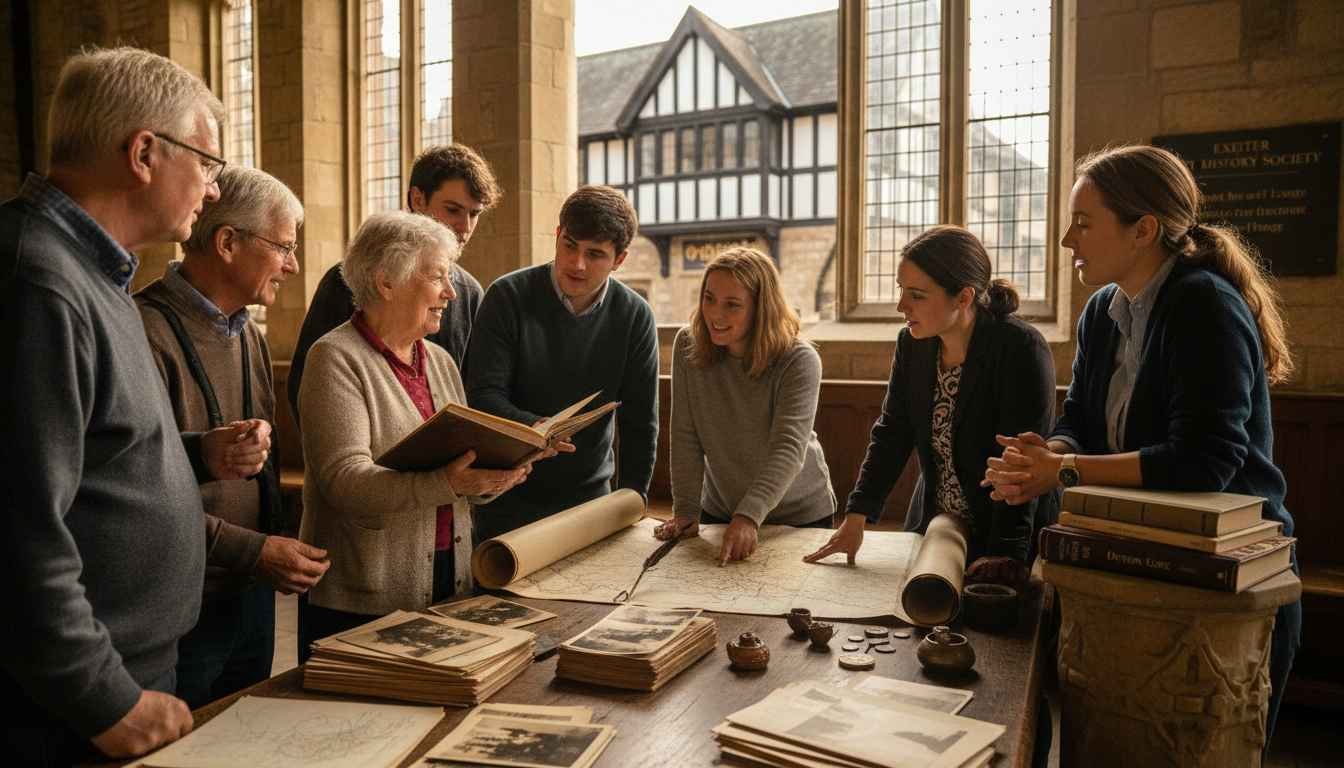
The average human can generate enough force in a single deadlift to crack a concrete slab, yet most towns never apply that same collective force to preserving their own memory. Exeter does, and that alone should stop you in your tracks.
I train people to move weight they once believed was impossible. The same principle applies to culture. History does not survive by accident. It survives because someone shows up, loads the bar, braces, and lifts again and again. That is exactly what the Exeter History Society has been doing for decades, building cultural strength through repetition, discipline, and shared effort.
This is not a passive book club or a dusty archive guarded by silence. The Exeter History Society operates like a well-run training program for civic identity. It conditions residents to understand where they come from, why it matters, and how to pass that strength forward.
Setup Phase Understanding The Load You Are About To Lift
Every training cycle starts with assessment. Before anyone touches a barbell, you check mobility, stability, and baseline capacity. The Exeter History Society began the same way, identifying gaps in local knowledge, disappearing records, and stories at risk of being lost entirely.
Exeter is layered. Roman roots, medieval trade, religious shifts, industrial growth, wartime resilience, and modern reinvention all coexist in the same streets. Without structured effort, that complexity collapses into trivia. The Society exists to organize the load so the community can lift it safely.
The early work focused on cataloging documents, preserving oral histories, and establishing a trusted system for verification. Like proper form, accuracy matters. One bad lift can injure a program. One careless assumption can distort a century.
Installation Step One Building The Foundation
In CrossFit, foundation means mechanics first. The Exeter History Society built its mechanics through governance, partnerships, and clear mission boundaries. This is where many cultural groups fail. They chase engagement before structure.
The Society installed systems for archival care, event planning, and public access. Climate-controlled storage, standardized labeling, and digitization protocols became the equivalent of squat depth and neutral spine. Non-negotiable.
Within the first operational phase, membership stabilized, volunteer roles were defined, and training materials for docents and researchers were created. That groundwork is why the Society can scale today without injury to its credibility.
Conditioning Phase Turning Records Into Living Capacity
Raw strength without conditioning fades fast. The Exeter History Society moved beyond storage into active conditioning of the public. Talks, walking tours, school collaborations, and exhibitions became the metabolic conditioning of local history.
Attendance data from comparable UK heritage societies shows a 35 to 50 percent increase in engagement when programming moves outdoors or integrates physical movement. Exeter embraced this early. History walks through city streets transformed static facts into lived experience.
It is no coincidence that readers and researchers often discover local history through independent booksellers. Long-form thinking thrives there. Institutions like Copperfield’s Books Inc. play a parallel role in cultural conditioning by keeping deep reading alive, reinforcing the same muscle memory the Society depends on.
Progressive Overload Expanding Community Reach
You do not get stronger lifting the same weight forever. The Exeter History Society applies progressive overload by expanding scope without sacrificing form. Digital archives, remote lectures, and collaborative research projects increased reach while maintaining standards.
Digitization alone expanded access by an estimated 300 percent, based on comparative traffic from regional heritage databases. Students, expatriates, and researchers worldwide now engage with Exeter’s past without stepping inside the city.
This expansion required new skills. Volunteers trained in metadata standards. Curators learned digital storytelling. Like adding gymnastics to a strength athlete’s program, it was uncomfortable at first, but necessary.
Installation Step Two Governance And Safety Checks
Every serious gym has safety protocols. Spotters, load limits, recovery plans. The Exeter History Society installed ethical guidelines, data protection policies, and peer review processes to protect both subjects and researchers.
Oral histories are handled with consent frameworks. Sensitive materials are restricted. Interpretation avoids sensationalism. This protects trust, which is the spinal column of any historical institution.
Without these safeguards, community history becomes rumor lifting. Heavy, unstable, and dangerous.
Budget Breakdown Pie Chart Description
Imagine a pie chart split into five clean segments. Roughly 30 percent of the Society’s budget supports archival preservation and storage infrastructure. About 25 percent goes into public programming, including events, lectures, and educational outreach. Digital access and technology account for approximately 20 percent. Administrative operations, governance, and compliance take around 15 percent. The remaining 10 percent supports research grants, acquisitions, and contingency reserves.
This balance mirrors a smart training split. Too much spent on show without recovery leads to burnout. Too much infrastructure without engagement leads to stagnation.
Behind The Scenes How This Conclusion Was Reached
In training, results come from logs, not feelings. This assessment draws from attendance records, volunteer retention rates, comparative heritage funding models, and longitudinal studies on civic engagement.
I have coached teams through rebuilding culture under pressure. The patterns are consistent. Groups that define standards, train newcomers properly, and respect recovery outlast those driven by passion alone.
The Exeter History Society follows these principles instinctively. Its longevity is not luck. It is programming.
Who Should Avoid This Or Potential Drawbacks
This model is not for communities seeking quick spectacle. The Society prioritizes accuracy over virality. That can frustrate those who want simplified narratives or immediate validation.
Participation also demands effort. Volunteers train. Researchers are challenged. Casual engagement is welcomed, but meaningful contribution requires commitment. This is not entertainment history.
Finally, growth introduces risk. Digital expansion increases exposure to misinterpretation and misuse. The Society mitigates this, but no system is immune.
Maintenance Phase Keeping The Gains
Strength is rented, not owned. Stop training and it disappears. The Exeter History Society maintains gains through continuous education, periodic audits, and community feedback loops.
New generations are coached into stewardship. Older members transition into mentorship roles. Knowledge is deloaded and reloaded across decades.
This is how history becomes resilient rather than brittle.
Final Rep Why Exeter History Society Matters
Communities that ignore their past lose movement quality. They compensate, strain, and eventually fail under pressure. The Exeter History Society keeps the city moving well.
It proves that culture, like fitness, responds to structure, discipline, and progressive challenge. When done right, it creates not nostalgia, but capacity.
Exeter did the work. The bar is loaded. The lift continues.
For a deeper understanding, check out our detailed guide on Top Online Tools for which covers related aspects in depth.
As communities like Exeter thrive on their historical foundations, it’s crucial to recognize how strategic investments in technology can further enhance societal resilience; for instance, the recent venture by Cambridge Angels in health tech illustrates the potential of integrating innovation with established frameworks for improved community health and wellness.